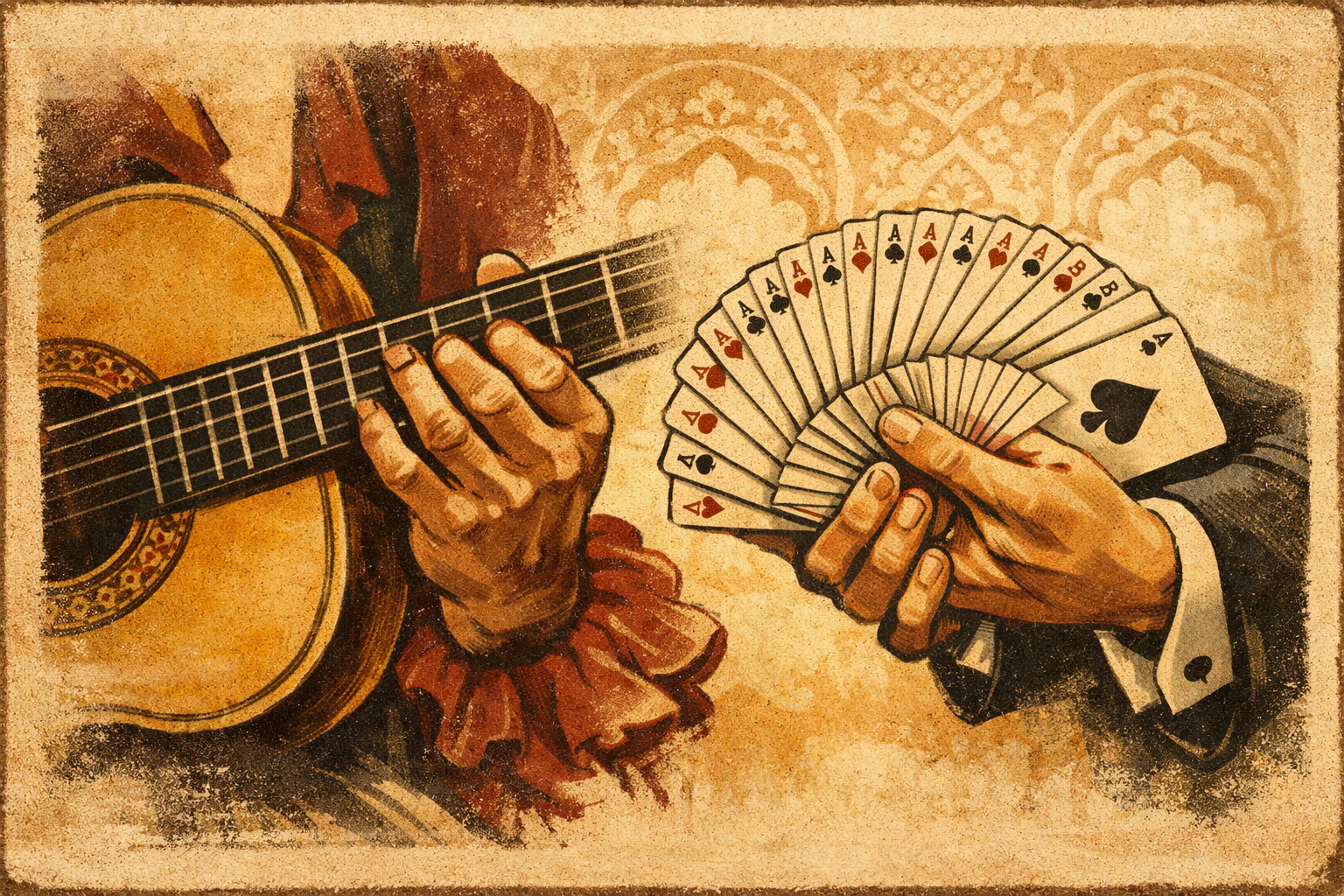
I recently watched an interview with the bassist Marcus Miller—a true master of his craft. A question came up that immediately reminded me of the art of magic: How do I find my own sound?
His answer was as simple as it was profound. A mentor had once told him: Don’t worry about your sound. It will develop on its own—if you play from the heart and have good technique.
I had to pause the interview and think. Because that applies just as much to us magicians.
The search for one’s own style
The question of one’s own style is one of the most common I’m asked. Young magicians want to know how they can stand out from the crowd. How they can become distinctive. And often they get all worked up about it.
They artificially try out different personas. They deliberately don’t copy anyone, which is just as forced as copying. Or they brood endlessly over their artistic identity instead of simply performing magic.
I understand this well. In my younger years, I too racked my brains over how to find my own style. I studied artists I admired and asked myself: What makes them so special? Why do you recognise a Vernon, a Tamariz, an Ascanio immediately?
The answer does not lie in conscious stylisation. It lies in something much simpler—and at the same time much harder.
The 1,000-Times Rule
Once you’ve performed a trick more than a thousand times, something magical happens in the truest sense of the word: the technique is no longer a conscious effort; it simply runs on its own and your fingers know exactly what to do. Your timing is spot on and the moves are second nature.
This is no coincidence. After sufficient repetition, the brain shifts motor processes from conscious thought to automated functions. What initially required full concentration becomes second nature.
And it is precisely now—only now—that the mental space you need is created in your brain.
Space for what?
For yourself, for your soul, your interpretation and your personality.
As long as you’re still thinking about the technique, you’re a prisoner of the method. You’re preoccupied with not flashing the card, not giving away the palm, not messing up the timing. Your brain is fully occupied with the mechanical aspects.
Only when the technique has disappeared—not from your hands, but from your conscious mind—can you truly play. In the musical sense of the word.
The Cañío Theory: When another’s art becomes your own
Here a concept comes into play that the great Juan Tamariz described in his theoretical writings: the Cañío Theory. The term originally comes from flamenco, and it is worth pausing briefly to consider its origins in order to understand the depth of this idea.
In flamenco, there are traditional pieces that are passed down from generation to generation. A young flamenco artist learns these pieces from his teachers, just as we magicians learn our tricks from books or from mentors. At first, he performs the piece exactly as he has learnt it. It is his teacher’s piece.
But over time, something happens. After hundreds, after thousands of performances, the piece begins to change. Not because the artist has consciously altered it. But because he has performed it so often that his own personality unconsciously flows into it. His timing, his emphasis, his pauses and his way of interpreting certain passages.
Eventually, the moment arrives that flamenco artists call ‘Cañío’: the piece has ceased to be the teacher’s piece. It is now his piece. It bears his fingerprint and has become unmistakable.
Tamariz has applied this concept to the art of magic, and it fits perfectly. Because that is exactly what happens with our tricks too.
You learn a trick from someone else. You perform it, over and over again. And without you realising it, small adjustments creep in. A glance here, a pause there, a word that suits you better than the original. Your body finds its own timing. Your voice finds its own rhythm.
What’s special about this process: it happens without conscious intention. You’re not trying to change the trick. You’re not trying to be original. You’re simply performing. And the change happens of its own accord, because it is YOU who is performing, and not someone else.
What Cañío really means
But wait. Before we go any further, we need to dig deeper. Because the word Cañío carries more weight than the previous explanation suggests.
Cañío is not a technical term. It is an aesthetic and emotional one. It describes a raw, ancient, unadulterated power born of experience, suffering, pride and groundedness.
A guitarist with Cañío does not play smoothly, polished or academically—but with rough edges, friction and life. You hear dust, heat, sweat, fatigue, pride and resistance.
Cañío is the opposite of elegant salon flamenco. It is expression with a history. Not beautiful in the bourgeois sense – but genuine.
And here lies the crucial point: Cañío is not technique.
A technically perfect guitarist can have zero cañío. And someone with limited technique can possess an immense amount of it. It is not about precision. It is about weight and expression.
When someone in flamenco says: “Tiene mucho cañío”—that doesn’t mean: he plays well or perfectly (why would it?). It means: this is genuine. This is old. This has substance. This comes from below, from the gut and from life, not from the head. It is a term of respect.
Historically, the term is linked to poverty, labour and marginalisation. To pride in the face of hardship. To the Andalusian underclass, the Gitanos, and street culture. That is why cañío is always a bit of a maverick. Uncomfortable. Not for the masses.
A good mnemonic: Cañío is to flamenco what patina is to an object, what grain is to an old film, what a growl is to a voice, and what cracks are to an old instrument—not flaws, but traces of life.
Interestingly, there is a related concept in Japan: Wabi-Sabi. This aesthetic, which stems from Zen Buddhism, finds beauty in imperfection, transience and asymmetry. A tea bowl with cracks, repaired with gold, is more beautiful than a flawless one – because it carries history. Wabi-Sabi and Cañío share the same core: the authentic is not the perfect. Yet whilst Wabi-Sabi comes across as more contemplative and quiet, with a gentle melancholy towards transience, Cañío is wilder and prouder. Wabi-Sabi whispers, Cañío growls. But both say: the traces of life are not flaws, they are the essence.
Cañío is a form of artistic expression that does not seek primarily to please—but rather to stand its ground and bring the honesty of the performance to the fore.
What does this mean for us magicians?
It means that one’s own style does not arise from smoothness, perfection or the attempt to please everyone. It arises from honesty, substance, the willingness to show one’s rough edges, and the refusal to polish oneself smooth for the masses’ taste.
A magician with Cañío does not perform to garner applause. He performs because he has something to say. His magic carries weight. It does not come from the head – it comes from below, from experience, from life, from the gut. That is rare, and precisely why it is so valuable.
The path to Cañío
What does this process look like in practice? Something like this:
After ten performances, you’re still performing the trick straight from the book.
After fifty, your first personal touches begin to creep in. A small gesture, a different tempo, a phrase that rolls off your tongue more naturally.
After a hundred performances, you realise the trick has changed without you having consciously planned it.
After five hundred performances, it begins to bear your fingerprint.
After a thousand, you realise: this is your trick.
Just as you can immediately tell with Marcus Miller: that’s his bass. Not because he’s trained himself to have a particular style. But because he’s played so often, for so long, so intensely, that his personality inevitably flows into every note.
Technique liberates
Many young artists see technique as a necessary evil. As something you have to work through in order to finally be able to be creative. This view is understandable, but it overlooks something essential: technique is not the opposite of creativity. Technique is the prerequisite for true creativity.
A pianist who still has to think about every fingering cannot improvise. A painter who struggles with the brush cannot bring his vision to the canvas. A magician who trembles with every sleight of hand cannot take his audience on an emotional journey.
Only mastered technique frees the mind for what truly matters: the performance of art, liberated in such a way that the performer’s soul becomes visible.
The organic process
What does this mean in practice? It means you can stop worrying about your style. Your style is already within you. It is just waiting to come to the fore.
But it can only come to the fore if you give it space. And you don’t create this space by brooding, but by mastering the technique.
Practise the technique until it is second nature. Not until it works reasonably well, but until it is truly second nature. Until you can do it in your sleep. Until your hands know what to do all by themselves.
And then perform. Again and again. In front of real people, in real situations. Every performance is a small step on the path to your own expression.
You won’t wake up one day and have found your style. It’s not a ‘lightbulb moment’. It’s a slow, organic process, like a tree growing. You don’t see it from day to day, but after years it is unmistakably itself.
Don’t waste energy searching for your style
And here lies an important insight: don’t waste your time searching for your style. The more you try, the further you drift away from it. You tense up, become artificial, think instead of feeling.
Your style isn’t something you find – it emerges on its own, through doing. Ask yourself instead: Is the technique really solid? Have I performed this piece so often that I no longer have to think about the ‘how’? Focus on that. That’s the only way.
Because when the technique is solid and you perform from the heart, the style creeps in all by itself. One day, people will say: ‘That’s unmistakably your thing.’ Not because you set out to do it that way – but because you’ve performed so often, so intensely, so honestly, that your soul has flowed into every move.
That is the Cañío. And it comes to those who stop searching and start working.
Don’t worry
Marcus Miller’s mentor was right. And his advice applies to every art form. Don’t worry about your sound, your style or your artistic identity.
Focus on what you can control: your technique, your discipline in practising and your willingness to perform in front of people.
Play from the heart. Conjure from the heart. Master your techniques, and then play often.
Your style will find you.